A non-trivial use case, for advanced users. The DBJ Taxonomy is complete without this page. The Five Facets View extends it, only for companies, teams or domains that need more detail than the tree gives. It is another layer of complexity, so use it only if you need it.
This document is the single source of truth for the optional taxonomy extension used to compose the “Item Declaration”: a more detailed description of an item already classified by the DBJ Taxonomy.
This is a concept behind a template that is used to crate “Five Facets View” aka 5F or 5FV; detailed view attached to an item classified by DBJ Taxonomy.
This DOES NOT replace the DBJ Taxonomy, which uses the fixed four-by-four tree. An item is always classified by the DBJ Taxonomy first. Attaching a Five Facets View is optional.
Facets of Five Facets View (5FV)
The 5FV Taxonomy is faceted. Each facet is a closed list of values, and an item gets one value from it. Tags list can have any number of tags.
| Facet | Values |
|---|---|
| Segment | Business, Product, Technology |
| Domain | Business, Information, Application, Technology |
| Abstraction | Conceptual, Logical, Physical |
| Lifecycle | Development, Deployment, Operations |
| Tag | Security, Integration, DataManagement |
Domain and Abstraction together form one matrix. An item sits in exactly one cell. This matrix is the format of an Item Declaration.
Stable IDs
It is not the number, the name is the ID. It is immutable and unique. Examples:
- IDs are facet-qualified:
Segment.Technologyis notDomain.Technology. - A matrix cell is
Domain.Abstraction, for exampleTechnology.Logical. - A child of a cell appends its name:
Technology.Physical.Compute. - A rename is a new ID plus a deprecation of the old one. Never an edit.
- Consumers pin a Taxonomy version.
Reminder: this whole concept is used for when organisation might require detailing and item beyond what simple DBJ Taxonomy Tree, can offer.
The Matrix
This is a classification template. It names the slots and their IDs. It holds no items: what the organization actually has goes into the empty slots, see the example.
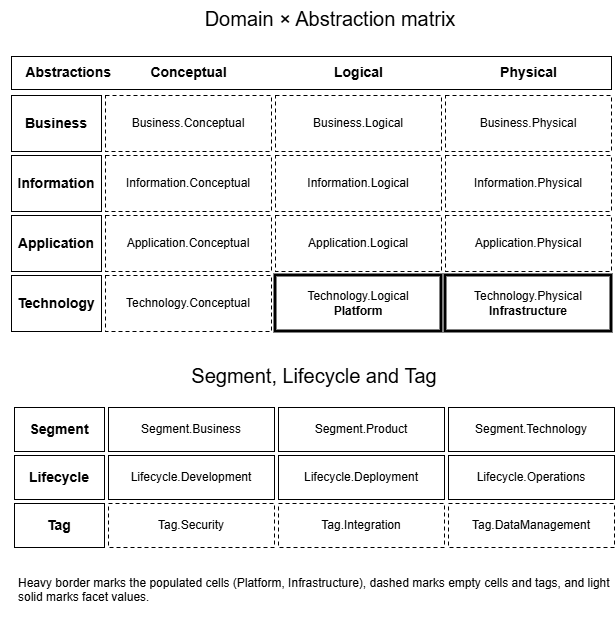
Legend:
- Heavy border: populated cell.
- Dashed border: empty for now. Domain × Abstraction cells are empty until populated, and Tags are dashed because they are applied to items rather than hosting them.
- Light solid border: facet value.
| Conceptual | Logical | Physical | |
|---|---|---|---|
| Business | Business.Conceptual | Business.Logical | Business.Physical |
| Information | Information.Conceptual | Information.Logical | Information.Physical |
| Application | Application.Conceptual | Application.Logical | Application.Physical |
| Technology | Technology.Conceptual | Technology.Logical — Platform | Technology.Physical — Infrastructure |
Cells without a name are empty until populated. Infrastructure has three children: Technology.Physical.Compute, Technology.Physical.Network, Technology.Physical.Storage.
Detailing an item classified by the Taxonomy
One Segment, one matrix cell, one Lifecycle value, any number of Tags.
Example: a Kubernetes cluster is Segment.Technology, Technology.Physical, Lifecycle.Operations, Tag.Security.
Tags apply to items. Items do not live in them.
Example: using the template
Illustrative items, detailed with the template. The template does not change; only the rows below are the organization’s own.
| Item | Segment | Matrix cell | Lifecycle | Tags |
|---|---|---|---|---|
| Customer order database | Segment.Technology | Information.Physical | Lifecycle.Operations | Tag.DataManagement, Tag.Security |
| Order API | Segment.Technology | Application.Logical | Lifecycle.Deployment | Tag.Integration |
| Container host cluster | Segment.Technology | Technology.Physical | Lifecycle.Operations | Tag.Security |
Each item has one Segment, one cell and one Lifecycle value. Only Tags repeat.
Segment.Product is a slot; the business declares what fills it.Vocabulary
1. Facets
In the context of a content a facet is one way of looking at an item. Each facet answers one question about an item, and has a short, fixed list of possible answers.
Think of a book in a library. Genre, Language and Year are three facets. Book facets answer one unique classification question: “Genre” and “Language”: they are different questions, about classification facets of an item; a book in the context of library content.
This Taxonomy is not about library of books, its five facets on each item, answer one unique question each:
| Facet | The classification question it answers |
|---|---|
| Segment | Which part of the organization does it belong to? |
| Domain | What kind of concern is it? |
| Abstraction | How concrete is it? |
| Lifecycle | Which stage is it in? |
| Tag | List of cross-cutting concerns that touch it? |
An item is classified by answering each question once (Tags: as many as apply).