Here we develop a micro but true library of 3 books. Final deliverable is folder of md files. Each is a record we keep for each book. Front matter of each md contains the classification. Some tool used by librarians, will use these files to answer the queries about the library. The front matter can be easily expanded (but not changed once in action). For example there is no information where the books are physically located. Here we have a version one, as developed for this library.
Version one
Specification
Each book is an “item”; and it is classified by the DBJ Taxonomy; each with an Item Declaration implemented as mark down document front matter.
The actual library items are books, classified and Item Declarations attached to each.
Here is the first three md files for first 3 books.
- Book: Lisp in Small Pieces
---
# Item Declaration
title: Lisp in Small Pieces
taxonomy: "Conceptual: Application, Technology"
lifecycle: Published
tags: [lisp, scheme, interpreters, compilers]
owner: DBJ
author: Christian Queinnec
publisher: Cambridge University Press
year: 2003
isbn: "9780521545662"
# Not part of the Item Declaration: document front matter
version: 0.1
---
---
# Item Declaration
title: "Typologies and Taxonomies"
taxonomy: "Conceptual: Information"
lifecycle: Published
tags: [classification, taxonomy, typology]
owner: DBJ
author: Kenneth D. Bailey
publisher: SAGE
year: 1994
isbn: "9780803952591"
# Not part of the Item Declaration: document front matter
version: 0.1
---
- Book: Theories of Programming
---
# Item Declaration
title: "Theories of Programming: The Life and Works of Tony Hoare"
taxonomy: "Conceptual: Technology, Information"
lifecycle: Published
tags: [hoare-logic, csp, verification]
owner: DBJ
author: Cliff B. Jones, Jayadev Misra (editors)
publisher: ACM and Morgan & Claypool
year: 2021
isbn: "9781450387316"
# Not part of the Item Declaration: document front matter
version: 0.1
---
After those 3 book are “itemised” and stored in their “item files” the library items folder might look like this.
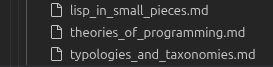
From pile of items to library
This obviously opens space for various tools to operate on the set of item. It adds structured information to the free form text. It transforms “free floating” set of item into library of items. In this example books.
In the method core, we also used “village library” as an explanation aid.