AI Primer
The architects’ view of the AI world.
Model, LLM, Instance, Harness
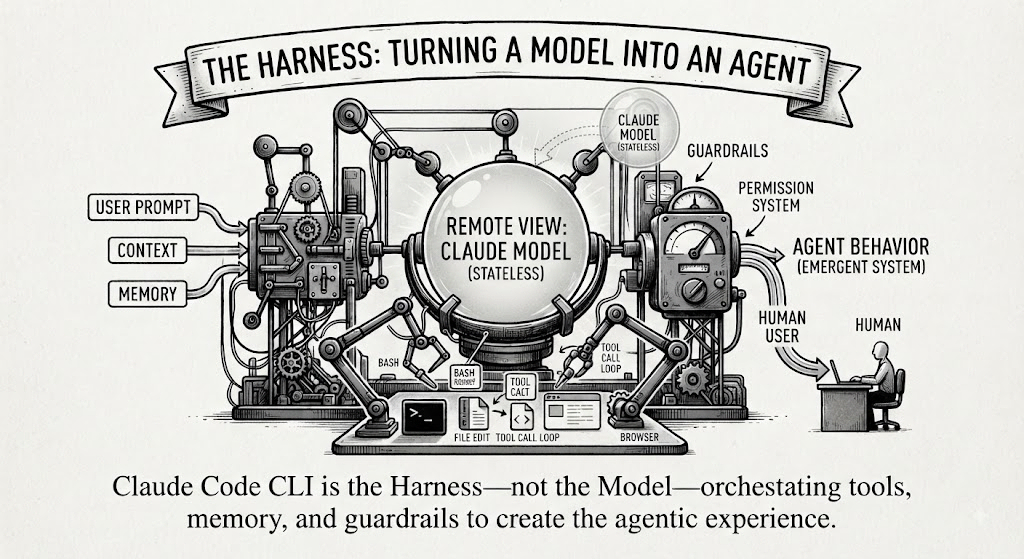
(that is just an caricature)
- AI : Artificial Intelligence. Has no single simple, universally accepted definition. Unfortunately marketing industrial complex has produced enough false definitions for public to be manipulated into believing AI is what marketing says it is. The best I can offer is this:
AI is not a technology. And the next best I can do beside that is to ask avid readers to visit Britannica on line suite, devoted to the subject. Where I did learnt, AI is far from being just a technology.
Further down the road, there are 3 key abstractions.
- Model: An abstract computational structure — architecture plus learned parameters — that maps input to output.
- LLM: A Model subclass constrained to transformer-based architectures, trained on huge piles of text.
- Sonnet5: A concrete LLM instance — Anthropic’s specific trained checkpoint with fixed weights, currently answering you.
Presented as an object oriented inheritance chain
Model (abstract)
  └── LLM : Model        // transformer, trained on text
        └── Sonnet5 : LLM // example, concrete: specific weights, specific release
That is a simple, effective explanation of what AI actually amounts to in 2026.
The Harness
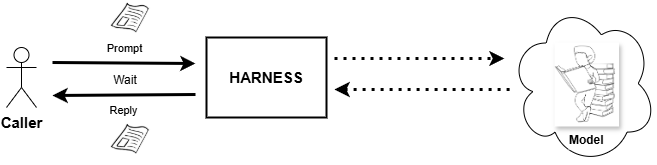
Harness is just a communication end point you use to chat with the Model. For example
Sonnet 5. Example of a manifestation of a harness on a windows desktop isclaude.exe. An normal Windows CLI program.
“Harness” is the term used in agentic-AI circles for the scaffolding around a view onto the model. In reality harness is the program containing tool-calling loop, permission system, context management. Operator using harness program (example claude.exe on Windows), experiences an LLM as an agent that can act. Claude Code is Anthropic’s harness for Claude: it wraps the model calling with file/bash/edit tools, a loop, and guardrails.
Claude Code, Cowork,etc. are example harnesses, the programs around the remote model calls. The local desktop tools are given to it (file editing, bash, browser, etc.); as well as how much memory/context it keeps, and what actions it’s allowed to take, on your desktop.
User (You) experienced behavior of the harness is dictated also by this fact: the model it references is stateless. Everything humans experience as “agent paraphernalia” (memory, tool use, multi-turn state) comes from the harness in need of orchestrating repeated calls to that stateless model, not from the model itself.
Vocabulary
Theoria mundi de architectorum
Abstraction
A name for what a thing does, with the details of how it does it left out.
Context
The text sent with prompt, to the stateless model on each call. The harness assembles it. Stateless means, the model has no memory of anything outside the context. It answers the prompt, sends the response back. Forgets if has ever happened.
Guardrails
Are the limits on the harness program’s activity. The human user experiences them as limits on what the model is allowed to do.
Paraphernalia
The assorted gear that comes with an activity, not the activity itself.
Category
See (for example) DBJ Taxonomy for an immediate usage in the context of IT supported commercial organization.
Further reading
(c) 2026 by dbj@dbj.org | MIT License